Monday, August 17, 2009

Bring Lex to Your Campus, Organization or Community Center!

This year Alexis is using her best developed and most cherished skill-the art of the life-changing workshop-to raise funds to support her decision to spend the next year doing the MobileHomeComing an immersive intergenerational community documentation and education project based on her lust for back queer community! (It's weird that somehow I have to be consistent with a choice to talk about myself in the third person here, but I want to interject in the first person to say that your support means everything to me and it is evidence of the fact that it is possible to be a community supported, community accountable scholar in the 21st Century. :)

Bring Alexis to your campus, community center, to speak, or do a workshop that you will never forget!

at the Furious Flower Poetry Center!

Lectures:

Alexis is available to speak on a variety of topics and has tons of experiences speaking to audiences at elementary schools, college campuses, community centers, rallies, conferences and workshops. Click on the links for examples of public talks she has given in the past. She might particularly be a great person to complement your community or campus programming during Sexual Assault Awareness Month, Love Your Body Week, Celebration of Black Womanhood Week, Black Heritage Month, Women's History Month, National Coming Out Day, Mother's Day or throw tokenism to the wind and bring Alexis to speak and make any old day of the year a day filled with hope and magic!

4495_1148688561670_1361255849_389085_216113_n

Alexis's Academic CV

4673_509449293997_162601031_30347254_1697275_n

Workshops:

(Most workshops are available either as a one time session, a day-long intensive or a series within the NC Triangle or Triad areas. Get in touch about what works best for your community. Below are workshops that I have facilitated many times before. I can also design workshops specifically for your needs :)

Movement

Pressed for Knowledge: Alexis has facilitated this miraculous zine making workshop all over the United States in communities, on college campuses and at conferences. In this workshop participants (whether they are part of an existing group or are meeting for the first time on the day of the workshop) use the resources of urgency, homegrown brilliance and whatever's around to create their own publication in less than 2 hours. Alexis leads participants in a process of choosing an audience, a theme that connects their passions and a work structure and a group evaluation process for their own urgent publication! (NEW!!! Pressed for Knowledge is now available in a video version...where participants create and edit their own video in an amazingly short period of time!) workin' on it!Grassroots Literary Production: Due to her experience leading the Pressed for Knowledge workshop and facilitating students at Duke University, UNC-Greensboro and the SpiritHouse Choosing Sides program in the creation of their own online and print collaborative publications, Alexis can train teachers, faculty and community cultural workers to make publication a part of their programming. bhopal imageThe Activist Impulse: Similar to the Pressed for Knowledge Workshop, this workshops leads participants through a process of deciding on, designing and enacting and evaluating a site-specific direct action. Alexis has led this workshop with a class of Duke University Students, at the Ethnic Studies and the Activist Impulse Symposium at Columbia University, the Beyond the Box Conference at Barnard College, the Anarchist People of Color SouthEast Regional Conference and more!

Legacy

(These workshops are grounded in Alexis's years of black feminist research and spiritual practice and are ideal for a community organization, school, department or group of people interested in how the theory, practice, poetry and lessons of black feminist practice apply to their present conditions) audreLetters to Audre: developed in a special writing enrichment course that Alexis designed for Africana Women's Studies majors at Bennett College for Women, this workshop or series of workshops introduces participants to key works by black feminist lesbian poet, scholar, activist Audre Lorde. Participants create their own versions of/responses to poems and essays by Audre Lorde including Litany for Survival and The Uses of Anger. Participatns also write their own poetic letters to this literary feminist ancestor. See www.letterstoaudre.wordpress.com for examples. Alexis is also available to lead seminars for faculty, teachers, and community educators on Teaching Audre Lorde. June_JordanLetters to June: Along a similar model as the Letters to Audre Workshop, this curriculum was developed for a feminist theory course at UNC-Greensboro. Participants will write their own "Poem About My Rights" and "What's Love Got to Do With It" and also engage some of Jordan's lesser known and unpublished pieces. Alexis is also available to use her privileged access as the first researcher to view June Jordan's archival papers to lead seminars on Teaching June Jordan. lorde_oldLitany for Survival: The Poetics of Community Building This writing and movement workshop, designed in collaboration with Ebony Golden starts from the grounding point of Audre Lorde's Litany for Survival and leads participants through a process of analyzing the poem for themselves, using theater of the oppressed methodologies to demonstrate what survival means for them and creating their own praise poems towards the survival of their own communities. This workshop was debuted at the Brecht Forum in New York City with an amazing response. 45hamiltonIn Your Hands: The Depth of Legacy: based on a spiritual experience that Alexis had of recieving and writing down letters from chosen, (and uninvited!) black feminist ancestors including Fannie Lou Hamer, Nayo Watkins, Toni Cade Bambara, Octavia Butler and her own grandmother (see the letters and the video documentation of the process here) this workshop is designed to facilitate participants in listening for and to the legacies of their own chosen traditions. Alexis will facilitate a disucssion of some of the insights in the letters she recieved and each participant will leave with a plan and a way to make space for their own insights.
Sustainability

(these workshops are designed to keep community members, community organizers, students and teachers ALIVE AND WELL with full access to their love for themselves, each other and their inspired purpose!) Photo 16Habit Forming Love: This workshop shares the gifts of a 21 day process in which Alexis sought to learn how to love herself, her partner and her community better and to train herself in online video production and distribution. Available as a one time workshop or a skills building series, this workshop will allow participants to use new media technology to deepen and activate their love for themselves, their chosen family and their communities. Browse Alexis's video project here. alexis is audre lorde againMother Ourselves: Created in collaboration with Zachari Curtis for the Gumbo Yaya Sister Circle, and inspired by Audre Lorde's essay "Eye to Eye," this workshop provides participants with a safe space to examine their thoughts about the meaning of "mothering," and allows participants to explore what it might mean to nurture, teach and transform themselves. In this workshop we work in partners, listen to our bodies, use mirrors and talk about the affirming and difficult process of reflections linked to our varied experiencs with mothering. 4864_92087517797_541817797_2162853_7570725_nSustainability for Organizers and Activists: The workshop, designed for (and with) the organizers and visionaries in Critical Resistance, is about ENDING ACTIVIST BURN OUT!!!! Remembering that we, our bodies and our spirits are the most important resources for change, this workshop facilitates organizers in identifying the resources that keep them inspired and practices that can keep/get us well. Every participant leaves with their own visible reminder of their own wellness insights!

Vision

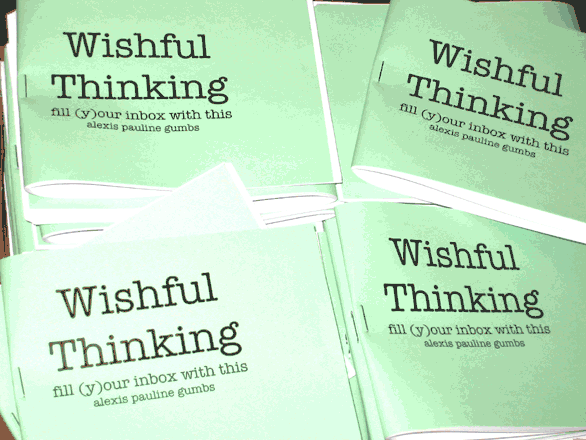
(These workshop are ideal for a community organization/project/coalition at a stage of inception or renewal.) -2Dig: Grounding Community Transformation in Local Resources Based on Alexis's poem dig, this workshop is designed to get community members in touch with the secrets, issues, and resources in their own communities and to build a shared analysis of those resources as a guide for their community projects and alliances. Each community will leave with at the very least, a group poem, new clarity about their resources and projects that connect and align their existing resources. The "dig" exercise has been enacted in Greensboro, Miami, Asheville and Gainesville as part of the Grassroots Media Justice Tour. wishful thinkingWishful Thinking: Vision and Actualization Based on Alexis's poem in honor of black women and survivors of sexual violence in her community and recorded as a track on the SPEAK! CD this workshop leads participants through a meditation about their desires for their local communities and communities of affinity. Participants will leave with a community wishlist and individual affirmations. To see some of the results of the version of Wishful Thinking facilitated with the Speak Media Collective at the Women and Action in the Media Conference see www.wakeupnew.blogspot.com.
Support the Work:

(all proceeds go towards Alexis's work on the mobilehomecoming project and do not include travel and accomodation. Priority will be given to institutions in Lex's home region of the North Carolina Triangle and Triad areas.)

Lectures:

Colleges and University-$1000 for lecture or poetic performance ($2500 for a lecture or poetic performance, Q&A and an additional classroom visit)

Community Center/Non-profit- $200-300 for lecture ($500 for lecture and workshop)

Autonomous Community Spaces (independent bookstores, churches etc.)- $100 for lecture(with the possibility of just passing the hat if we can also have publications for sale)

Workshops:

( each workshop will result in a publication/poem/major accomplishment for participants to keep and for the sponsor to be proud of!):

Colleges and Universities- $1000 ($3500 for a series)

Community Center/Non-profit- $300-500 (discounts for smaller or rural orgs, talk to me) ($850-1000 for a series)

Living Rooms/Kitchen Tables- $100 or gather your people, pass the hat and have some yummy food on hand and I'm there!!! (maybe I was a travelling black feminist preacher in a past life...)

All suggested prices are really suggested. Get in touch. (brokenbeautifulpress@gmail.com)

We can work something out.

Wednesday, August 12, 2009

First Ever Eternal Summer of the Black Feminist Mind PODCAST!!!!

audredeveaux_alexisjune-jordanVIIB29

Check out this FIRST EVER PODCAST as part of the BrokenBeautiful Press educational campaign "Eternal Summer of the Black Feminist Mind." Black Feminism LIVES by every means necessary.

What does it take to survive a year like 1979?

This first podcast is about the year 1979 and how the world, and black feminism began and ended in some crucial ways that year. With the election of Ronald Reagan, the Boston Murders, the Atlanta Child Murders and the Greensboro Massacre all attacking the the lives, minds and spirits of black women 1979 was a crucial year. This podcast focuses on how Audre Lorde, Alexis DeVeaux, June Jordan and Barbara Smith reach(ed) across time and space to transform the meaning of survival. (And there is some good period appropriate and anachronistic music too!)

download to your itunes here:
http://brokenbeautiful.wordpress.com/files/2009/08/1979.m4a

Please leave comments here!

p.s. Sorry about the moments of outburst distortion. A sista is clearly super exuberantly excited about black feminism and promises to stay a little further away from the mic on podcast number two! :)

Monday, June 22, 2009

Combahee Survival Activity!: Sprung

Yes!!!!! We are at the cusp where spring fever turns to hot sticky summer lust. I love this time of year...and all the bad and good decisions that come with it. And I'm so happy to be in black feminist intellectual lust with all of you!!!!

This week the Combahee Survival exercise is about completing a poem made from these words...


“Above all else, our politics initially sprang from the shared belief that Black women are inherently valuable, that our liberation is a necessity not as an adjunct to somebody else’s but because of our need as human persons for autonomy.”
Complete the poem:

above

sprang shared

liberation

need

Post your poems below or email us at brokenbeautifulpress@gmail.com

For example: Alexis Charles who says she usually does NOT write poetry contributed this beautiful elaboration:

1. Not from ABOVE

But from within.

You gave life to words.

That gave me life.

Words that

SPRANG from our SHARED oppressions, fears, dreams and joys.

Calling for our LIBERATION.

Illuminating our NEED.

2. When I had lost faith in everything ABOVE.
What SPRANG from the depths of your hearts.
Let me know my pain was SHARED.
The not so quiet call for LIBERATION
Those words
“black women are inherently valuable”
Held me softly, tenderly, gently,
Quieted the dull aching NEED
Wrapped me in love and solidarity

3.

we
ABOVE
Where do exist?
below
I
Your words

S
P
R
A

iNto motion a well-spring of truth, knowledge and love gushing from the valleys of your thoughts,
G through the canyons of your silences, over the cliffs of your screams.

I SHARED my fears and dreams with you and I realized I’m not the only one

MyLIfeisnotanisolatedabBERATION

In moments of NEED you
answer.’


Cynthia bringing the light!

Cynthia bringing the light!

Cynthia Oka, radical mama and feminist indigenous rights organizer in Vancouver wrote:

5:47 am

pungent is the aching flesh over hard bone

it is no luxury to choose

liberation

rising dawn

droplets of sun on my skin

stinging like ice

i must search again

build dig tear from towers of tyranny

hope

all that demands our breaking

a million footsteps marching on my chest

fear not fear not

the arms of my mothers

spears sprang against cannons

today so too do mine

that is my blood spilled shared

that is my life-giving love

that is my claim

on freedom

above this colonial landscape

i embalm my body

and choose to grace this day

with my presence

i am no finely cut diamond

i am the raw earth

on which your build your throne

i desire no queenhood

i am higher than price

stars breaking in sky

this is my spirit

cage me wage me

snap every joint

i rewrite the universe

through my undoing

we are our prophets

persistent as dew

fear not fear not

we are all we need

Tuesday, June 09, 2009

lexical earthday


Oh wow y'all! Before the week is out I will be 27...also known as GROWN!!!!
Feel free to send wishes, love, and advice. I am thrilled about the juicy goodness of knowing you this lifetime!

I hope you can make it to my b-day potluck brunch at 1pm on Saturday June 13th on my porch.
Here is the reading and bring something yummy.
And feel free to make a donation towards my birthday gift seminar at the Furious Flower Poetry Center too at paypal to the email brokenbeautifulpress@gmail.com

Wednesday, May 20, 2009

Gospel: Body, Deviance and Soul

Hey fam!

Check out my review of Samiya Bashir's new book of poetry from independent black gay and lesbian publishing company RedBone Press. Here is an excerpt, please read the full review and join the conversation at Blackademics.org

love,

lex

gospel_cvr.jpgSet in the mouths of crows, on the edges of couches and dirty tables, and in the hands of the dispossessed, Bashir’s poems awaken a desire to caress the mundane, hoping your fingers will find divine crumbs of revelation. Bashir’s project, inhabiting the tradition of black gospel music’s straddling contradiction, standing in the sacred and the profane, is timely. In a moment when the question of the relationship between faith and sexuality has been put in the media limelight through the discourse of marriage amendments, this project takes a step back, redefining both sexuality and salvation with a close look at the infinite places and moments when the human body meets despair, pleasure and transcendence...

Tuesday, May 19, 2009

Zora!

Zora! Festival


have you all seen this? http://www.zorafestival.com/index.html

FYI: FW: CFP
You have probably seen the call for papers below, posted at our website
over the last year, for the 2010 Zora Neale Hurston (ZNH) Festival of
the Arts and Humanities in Eatonville, Florida (USA) January 23-31,
2010.

The JUNE 1st deadline is around the corner, and your submissions is
enthusiastically anticipated from across disciplines and areas of study.

PLEASE FORWARD THIS EMAIL TO YOUR FRIENDS, COLLEAGUES , and LISTSERVES.

Taking a minute to forward the email below can make a world of
difference for this academic forum and for the sustainable development
of Eatonville, America's oldest incorporated African American town in
the US.

[Cultural preservation activism has helped this community survive urban
gentrification]

Questions?
See the call below and feel free to contact me directly.

Dr. Deidre Helen Crumbley: ZNH National Planner
Associate Professor/ Africana Studies Program
Interdisciplinary Studies Division Box 7107
North Carolina State University
Raleigh, NC 27695-7107, USA

CALL FOR ACADEMIC PAPERS
Invitation:
Scholars are invited to submit papers for the 2010 Zora Neale Hurston
Festival of the Arts and

Humanities (January 23 - 31). The festival theme is "Reflection on the
Life and Legacy of Zora Neale

Hurston 50 Years After Her Death."

The legacy of Zora Neale Hurston is a phenomenon that has undergone a
remarkable

development and expansion in recent decades, embracing, among others,
topics in ethnic identity, social

interactions, feminist theory, and cultural continuity. Hurston's unique
insights into folklore,

performance, and creative expression have invited new interpretation and
inspired emulation, while the

corpus of her own work has grown as a result of research and discovery.
The committee will welcome

papers exploring the dynamic dimensions of the Hurston legacy from
theoretical and/or historical

perspectives and will be especially attentive to appropriate
consideration of past, present, and emerging

scholarly content.

In a tradition of excellence, scholars are encouraged to engage the
literature and discourse of

their respective fields at the same that they present their findings
during the public forum in a form that

is accessible to academics in other disciplines and is also
intellectually stimulating for an intelligent

general audience.

Submission Instructions:

Submit a 150-word abstract along with an 500-word summary of your paper
that of your paper that indicates the

thesis or central question, which you plan to explore, as well as an
idea of the theoretical framework

within which your findings will be considered.

Deadline:

Abstract and summary are due June 1, 2009.

If your work is accepted for the festival, a copy of

the full paper must be submitted by November1, 2009.

Email your submission to:

Deidre Crumbley @: deidre_crumbley&ncsu.edu

AND

N. Y. Nathiri @: apec@cfl.rr.com


Then Mail a Hard Copy to:

Hurston Papers 2010

Preserve the Eatonville Community, Inc. (P.E.C.)

227 East Kennedy Boulevard

Eatonville, Florida 32751

Thursday, May 07, 2009

Forget Hallmark: Why Mother's Day is a Queer Black Left Feminist Thing

UBUNTU mamas this is dedicated to you!

The Anti-Social Family by Michele Barrett and Mary McIntosh (1982)
Fear of a Queer Planet ed. Micheal Warner (1999)
Aberrations in Black: Towards a Queer of Color Critique by Roderick Ferguson (2004)
"Of Our Normative Strivings: African American Studies and the Histories of Sexuality" by Roderick Ferguson (2005)
"Queerness as Horizon: Utopian Hermeneutics in the Face of Gay Pragmatism" by Jose E. Munoz (2007)
"A 'New Freedom Movement of Negro Women': Sojourning for Truth, Justice, and Human Rights during the Early Cold War" by Erik S. McDuffie (2008)
Blood Dazzler by Patricia Smith (2008)
Something Like Beautiful: One Single Mother's Story by Asha Bandele (2009)*


My mother is black. So the means through which I was produced is a matter of national instability. My mother is black. So the trace of slavery waits every moment to ink my body with meaninglessness. My mother is black. So my living is a question of whether or not racism will be reproduced today. My mother is black. This same piece of information threatens my survival. But my mother is black, which is at the same time the only thing that makes my survival possible.

It's early morning. I am a little bit drunk on the sound of rain, but it occurs to me that I should get (you) ready for mother's day. It is very easy to notice that I am obsessed with mothering and mothers. Mother is the single most interesting and confusing word that I know. Next to black.

And here comes mother's day. For me this year mother's day means a million things. Expectancy, fear, obligation, inspiration, joy, admiration, deep reflection. A few weeks ago my mother told me that she thinks I will be such a great mother. It struck me that while I have always dreamed of becoming a mother, and intended to become a mother, it always comes as a surprise when anyone affirms that it is something that I can do, SHOULD do even. Because I live in a culture that criminalizes black mothers for creating and loving black children, a culture that criminalizes black kids for being born. And latino kids too. I have been taught that mothering is something that happens to you, and you deal with it, and fight for it, swallowing down shame and living with the threat that the state wants nothing more than to take your kids away from you in every way imaginable.

But it is not my mother who taught me that. My mother repeats again and again that mothering us is her greatest accomplishment, like asha her enduring joy and triumph despite everything. And trust, she has other great accomplishments. My mother, not through perfection, not through ease, but through sincere struggle, intense and even sometimes overwhelming love taught us something in her very being. My sister (now an ambitious account exec in New York) once confessed to me that though it might seem unfeminist the only thing she really cared about, the one thing that she knew she wanted to do for sure was to be a good mother. And I told her what I more recently wrote in a poem to one of my feminist theory students, who blessed up by bringing her daughter to class, "mothering is the most feminist act of all." My mother, like every black mother, has been slandered. But we know a lie when we see it. My brother wanted to punch every producer of CNN's disgusting "Black in America" series for daring to suggest that being raised by a black mother was the key liability destroying the life chances of black people. How dare they? How dare they? When our black mother is the only reason we know how to breathe and survive despite the toxic racism filling this world. How dare they?

It is no mystery why it is a cultural truth that talking about a black person's mother is a great way to unleash a universe of anger. Our mothers are slandered every single second of every single day. The media does it like it's it's job. And indeed it is.

And here is the risk. All this talk of mothering, all this affirmation and priviliging of mothering puts me at risk, not only in a mainstream narrative working to reproduce a nation built on racial hate and genocide, but also on the academic queer left. It is not very queer of me to keep talking about my mother this way. In fact (as Micheal Warner suggests) the only queer way for a black person to talk about a mother is the "irony" of the house mother in black gay ball culture. CNN is dead to me. The deeper betrayal is that queer studies participates in the slander of the black mother, agreeing with the story that says she should not exist.

Has Warner not considered (as Cathy Cohen makes very clear in Punks, Bulldaggers and Welfare Queens) that black mothering is already a queer thing? Because we were never meant to survive. So the Queen Mother in the house movement is not just throwing shade, the queen is doing the necessary work of mothering. Of saying these bodies black and queer almost to redundancy, these spirits that every facet of our society would seek to destroy, MUST survive and WILL transform the meaning of life whether you like it or not. That is what a black mother does. Sincerely. It is no joke.

So this week I have been picking a bone with a queer theory narrative that sees mothering as the least radical thing one can do, in so much that it becomes irrelevant to the majority of the discourse on queerness. Clearly, like Moynihan, they don't know my mother. Asserting that the labor of mothering is always in collaboration with the reproductive narrative that reproduces heteronormativity ignores the fact there has been a national consensus for centuries that black people should not be able to mother and every force, from coercive sterlization, to workfare has been mobilized to try to keep them from doing it. Where has the dominant (read white) queer theory been while politicians have been ranting and raving about how welfare queens, (which despite the actual statistics becomes a code name for poor and racialized mothers) are going to destroy civilization as we know it by not only creating black surplus children, but by influencing these children with their deviant and risky and scary behavior? And isn't this the organizing desire of queer theory....to destroy civilization as we know it?

I just wish everyone would listen to Cathy Cohen (who by the way is a black co-mother to a beautiful fierce black girl-child) so I wouldn't have to stand here screaming (or more accurately sit here taking deconstructing and rebuilding the premises of queer theory all week long). But here is the quick and dirty of it...mainstream queer theory as inaugurated by Warner's edited volume and influenced by a Marxist feminst tradition of critiquing the heteropatriarchal family as a complicit force in the reproduction of capitalist oppression throw the black babies out with the bathwater of their universalism. The "tyranny of motherhood" as described by Barrett and McIntosh does not leave room for those other deployments of "mother" and "hood" (excuse me "inner-city") in the American vernacular of culture of poverty discourse.

This is why Hortense Spillers should be required and repeated reading for queer theorists. Four words. Mama's Baby Papa's Maybe. Which means there is no reason that the act of mothering would reproduce patriarchy, or even take place within the confines of patriarchy along normative lines because the practice of American slavery has so fundamentally ripped the work of mothering from the bodies of black mothers (forcing them to do the labor of mothering for white and black children while fully denying them any of the authority of motherhood by killing and selling away and raping and mutilating their children. (I have posted here before about my discovery, while reading slave code, that even a free black mother had no legal right to defend an enslaved daughter from abuse by a slave master.)

The complexity of the term mother (next to black) requires a queer theory that deuniversalizes race and highlights the function of racism in reproducing the heteropatriarcal status quo. Cathy Cohen, Roderick Ferguson and Jose Munoz do this work of reminding us that Third World Feminism and the Third World Gay Liberation movement are an alternative starting point (contemporary with the Marxist feminist arguments that Warner's version of queer theory inherits). Their work is crucial because it says something very obvious. We are people of color. The whole system wake up every day trying to exterminate our bodies and our spirits. Our very survival is queer.

We were never meant to survive, and if mothers are part of why we are here (and they are), then they are the queerest of us all. But this is not even news. If we remember what black women have been up to in the United States we can just go ahead and let go of the asumption that mothering is conservative or that conserving and nurturing the lives of black children has ever had any validated place in the official American political spectrum.


Eslanda Robeson
Charlotta Bass
Shirley Graham Du Bois
Mary Church Terell
Maude White Katz

Take the fierce black women writers, mothers, publishers, actresses, activists
who would become the Sojourners for Truth and Justice and their work starting in the 1940's to protest the imprisonment of Rosa Lee Ingram a black mother who was sentenced to death for standing up for herself, and defending herself against a white man who tried to rape her. It was black women activists who changed her sentence to life in prison and then eventually (after 12 years incarceration) got her released from prison. And always always the key word in their organizing strategy was "mother." Their key understanding of Ingram who was willing to fight to keep this violent man away from her body and away from her children epitomized the term "mother" for this set of black woman revolutionaries. They framed the state's violence against Ingram as a violence against black mothering itself. How dare this black woman take a stance against rape. Standing against rape is a mothering act. How dare she threaten the perceived truth about what happens to black people, that black bodies are infinitely rapeable. How dare she stand ferocious, daring and teaching. This is what will happen to you if you come at me. This is the act of mothering that mobilized a national movement, black women gathered twenty-five thousands signatures for a petition in 1949...way before the era of the text message e-blast petition. They made it an international human rights issue, contacting every single member nation of the UN. And I need you to know this, remember this if you remember nothing else:

On Mother's Day, exactly 60 years ago the black left internationalist feminists of Ingram Committee sent TEN THOUSAND MOTHER'S DAY CARDS to the White House and scared Harry S. Truman so bad that he made up an excuse to miss their scheduled meeting the next day.

Ten thousand mother's day cards from black women to the white house. Stolen holiday. No justice, no peace in the form of ten thousand paper-cuts. A floral dare saying: celebrate this. This is what mothering means: organized support for radical self-defense. A complete refusal of rape by any means necessary. Ten thousand Mother's Day cards. A threat saying we are black mothers. We are survivors. Try us.

Forget hallmark.

Have a revolutionary Mother's Day people.


*(Outside of the above timeline, sit Cathy Cohen's "Punks, Bulldaggers and Welfare Queens" and Hortense Spillers's "Mama's Baby Papa's Maybe" which i did not reread this week...but have completely internalized such that I should be understood to be citing them no matter what I am saying about anything.-apg)

Monday, May 04, 2009

BrokenBeautiful Blooming!: The Spring Update

It's Spring!!! That bright, sexy season when we remember the full color of the world and everything becomes possible again! So what better way to celebrate the rebirth of the planet than to break your beautiful spirit out of its shell?

BrokenBeautiful Press (www.brokenbeautiful.wordpress.com) is ready for your reawakening with exciting new projects for you to check out, participate in and support.

On the move:

a queer black mobilehomecoming


BrokenBeautiful Press is partnering with Queer Renaissance to embark on a monumental journey in celebration of the bravery and genuis of the trailblazers of the black queer/lesbian/gender-non-conforming community. Think "black lesbian Eyes on the Prize" y'all! A year from today Alexis and Julia will be getting in an environmentally sustainable RV and hitting the road to learn, document and transmit the legacies of brave black queer warriors who have been transforming the meaning of life since the 1980's or earlier and hosting amazing intergenerational community education events all over the US. To find out more and to offer resources, advice or financial support go to: www.mobilehomecoming.wordpress.com

SPEAK!: Support Radical Mamis of Color!
BrokenBeautiful Press is proud to celebrate the birth of the most radical spoken word CD ever. Think This Bridge Called My Back in audio form! Speak Media Collective, a group of radical women of color transforming the world through new media, has launched a self-titled spoken word CD as a grassroots fundraiser to support the participation of young mothers of color in the Allied Media Conference. Help moms and kids of color travel to this national media gathering and get your mind blown at the same time. The CD includes a zine and a curriculum guide for using the CD in your community and classroom. To get your copy go to www.speakmediacollective.com

Community Education:
Combahee Survival: A Movement Revival:
In 1977 a crew of radical black socialist lesbian feminists wrote a document that changed the landscape of social justice forever. More than 30 years later young black feminists are tracking the survival of the analysis of interlocking oppressions and holistic transformation that the members of the Combahee River Collective stood for in the progressive community at large. The Combahee Survival Project is a dispersed community education project that shines light on and nurtures the seeds of a radical intersectional approach all over our social justice movement. Go to www.combaheesurvival.wordpress.com to see poetic activities that draw on the words of the original statement, examples from community organizers who are still wrestling with the issues the collective raised and worksheets to use in your community, and look out for the Survival/Revival activity of the week brought to you by BrokenBeautiful Press all summer long!

Eternal Summer of the Black Feminist Mind
In Durham, North Carolina (aka vanguard city, center of the universe) a growing, diverse and beautiful group of folks have gathered in the name of black feminism. With delicious potlucks to discuss key essays by black feminists, fieldtrips to hear black feminist poetry, and more we are acting on our faith that the radical work of visionaries like Claudia Jones, Angela Davis, June Jordan can inform and transform our city and our lives. And like-minded devotees in Chicago, DC and other cities have joined in. Follow along, find out about upcoming events and download free reading material at www.blackfeministmind.wordpress.com

Interact!!!!!

Habit Forming Love: The Video Project:
They say it takes 21 days to form a habit, so your girl Alexis decided to cultivate the habit of loving herself and her people (you!) fully, bravely, loudly and proudly. What better habit could there be? Experimenting with (and teaching herself) the art of internet video production and sharing she created videos of love for self, love in community and growing love for her sweetheart. Now it's your turn! Go to www.habitforminglove.wordpress.com
to browse Lex's videos and make your own!

In Your Hands: Letters from Ancestors
Alexis started the year with a life-changing, spirit-humbling process of receiving letters from black feminist ancestors who gave loving advice, welcome reminders and sometimes difficult challenges and lessons. Read letters from Audre Lorde, Octavia Butler, Lydia May Gumbs (lex's grandma), Toni Cade Bambara and more at www.motherourselves.wordpress.com and add your own letters about your communication with your chosen and familial ancestors.


It's Spring! Anything is possible, even you and the life-changing love that makes your spirit tingle and grow.

Stay fly!
love always,
BrokenBeautiful Press
brokenbeautifulpress@gmail.com

Monday, April 27, 2009

Flamboyance

Hey all. This is a talk I gave yesterday at Radical Intersections a performance studies conference at Northwestern University. Let me know what you think!
love,
lex


Flamboyance: The Queer Survival of Black Feminism

Alexis Pauline Gumbs

Dedicated to Pauline McKenzie and Andria Hall

May I begin with an invocation?
This instant. This triumph. Black feminism was never meant to survive. This instant. This triumph. This is ritual. This instant and this triumph. Black feminism was never meant to survive. But here I am. Here we are. That is the queer thing. In 1981 by the time I was in my mother’s womb every explicitly black feminist organization in the United States was defunct, and the black women’s writing publishing trend was effectively over. Some say that black feminism went academic, went textual. Some say black feminism went new age, got touchy feely, stopped taking to the streets. Some say black feminism is anachronistic, useful only as a referent, a supplement, a precedent for something else. Black feminism (remember) is how we got this idea of interlocking systems of oppression, demarginalizing the intersection. But I have not heard anyone talk about the Combahee River Collective here. I have not heard us lift up the name Kimberlé Crenshaw yet at this conference about Radical Intersections. Hmm. It seems, black feminism was never meant to survive. And the queer thing is, here we are.

This is how I make my body legible to ancestors who I cannot choose or name. This is how I make my work accountable to swallowed rage in the mouths of people who were not invited. This is how we commune with the forgotten, reframe the possible, this is how we remember that we don’t know where we come from. This is makeshift reverence for pathways that do not meet, a time space that is not continuous. This is what her hand writing has to do with my slow breathing. This is what her late nights have to do with my early mornings. This is what his bitten tongue has to do with my declaration. This method is survival as performance, speech as meditation, memory as clothing, ocean as audience. This room is full of something that I will name black feminism. Tell me when it starts to burn.

Flamboyant. First an architectural term describing the construction of castles with framing blades, the colonial understanding of flowering trees, the Oxford English Dictionary remembers that flamboyant meant many things before it meant us, those of us who do not know better than to hide our brilliance, the transformative ones, burning like hell as we walk the earth. This meditation examines the way that black feminism survives in the queer bodies of work, bone, muscle and breath that remain, invoking the little known work of the Flamboyant Ladies, a performance group created by black lesbian feminists Alexis De Veaux and Gwendolyn Hardwick in their living room. This presentation situates the forgotten work of the Flamboyant Ladies, who created radical t-shirts, performance pieces, salons and a full day presentation about the impact of the nuclear moment on black communities in the 1970’s as a haunting, illegible precedent for the more contemporary work of UBUNTU and BrokenBeautiful Press, two initiatives based in Durham North Carolina that similarly use embodied poetics to respond to systemic violence, against women of color in the wake of the Duke Lacrosse and Dunbar Village cases and the torture and sexual assault of Megan Williams.
Seeking an embodied poetics of queer intergenerationality, a relationship between ancestors, elders and youth that survives by rejecting the social reproduction of oppression, rejecting the assumption that queerness and intergenerationality are mutually exclusive especially given the mandate that some of us are criminalized when we reproduce life and create family, this piece takes Flamboyance, that dangerous, queer stance, as a trajectory for the livelihood of feminism, taking seriously the (often cancerous) impact of the unceasing labor of and punishment for radical feminist work on the bodies of queer elders and ancestors including De Veaux, Hardwick, and collaborators, June Jordan and Audre Lorde. This is a work towards healing and survival. Healing and survival are queer methodologies for oppressed communities because we were never meant to survive. This is a collaborative offering of our bodies across time to the intergenerational work of performing, and making possible, the world we deserve.
The Flamboyant Lady Should Not Exist
Flamboyant Ladies co-founder and radical black lesbian feminist Alexis DeVeaux explains, “By the time Reagan came to power, opportunities for black women writers and artists, began to dry up in drastic kinds of ways. Publishers say ‘we have enough black books.’ The NEA becomes explicitly conservative.” Black women artists cannot support themselves with grants and publishing contracts from a lustful consuming public fascinated by the glamour of the self-articulation of black and feminine subjectivity. The novelty has worn off, it is no longer interesting that someone can be a woman and a black person at the same time. In fact by 1981 the Moynihan’s matriarchy thesis has become law and the danger of black women has become apparent. Reagan has by this time, coined the term welfare queen, that black woman who threatens the new neoliberal economic order by the criminal act of bearing black children, expendable and expensive drains on an increasingly anti-social economy, that black woman who threatens the logic that flesh and labor have differential values by loving black children as if they were priceless, that black woman who threatens the anti-social norms of late capital by raising children that will not consent to the terms of the economy, this crazy black woman who lives as if housing, and education, and food were community concerns. That crazy black woman, with the nerve to survive and to wear bright colors, big hair and a loud mouth while doing it. She is a problem.


The intersection is not a radical sexy place of queer and salient knowledge production at this point. The intersection is the place where June Jordan, Gwendolen Hardwick and Alexis DeVeaux have guns pulled on them by the New York City police occupying black neighborhoods in Brooklyn. That intersection has much more in common with the intersection that Crenshaw actually described, the traumatic scene of a violence that neither the law or the existing anti-oppressive theory could fully address, than with the logic of accumulation that we use to market ourselves as increasingly complicated scholars in an academic industrial complex primed to consume our difference. So maybe what these black feminists created at their particular juncture has something to teach us, now.
*
I never knew that waking up every morning with a new idea and ironing it on to a t-shirt for two years was an apprenticeship. I didn’t know that navigating the issue of socially transformative childcare with the idea that queer folks should dance and prisons should be abolished forever was a vigil I participated in towards the survival of my elders, I didn’t know that enacting healing as performance with a women of color led group of survivors of gendered violence was much older news than I could have imagined. I thought that I and we were, to quote Essex Hemphill, “making ourselves from scratch.” Our stories are not recycled and distributed on the wings of capital, so I became an eclectic priestess, ritualizing cotton, stickers, and the word yes. Experimenting in community with how our needs became analysis. I had no idea that I was an initiate in a practice called black feminism because the mode of black feminism that I practice, that we practice in my community is the forgotten, unpublished part of the story. But here we were speaking the lines, setting the scene, dancing the navigation home.

This is the only way I know how to tell you about the experience I had one day in the files of the African Ancestral Lesbian Archive, files of an archive that no longer exists, held in the all volunteer run brownstone of the Lesbian Herstory Archives in Brooklyn. My hand brushed across a flyer, a woman and then that same woman printed twice, partially hidden by the other’s hair, because it was big hair wild hair familiar hair, from my standpoint. Huge earrings, and full open mouths, the Flamboyant Ladies were hosting a performance in their living room to benefit “No More Prisons” a campaign by women to stand in solidarity with women in prison followed by a “women’s only” party with free childcare. I didn’t breathe as I turned to the next sheet with those same mirror image women thanking a community for supporting the daylong festival and t-shirt making initiative they had held about the question of how the anti-nuclear movement impacted black communities in the United States. I found an invitation to a traumatic (playing on the term dramatic) mythic performance designed to ignite healing by examining the sound, feel and timbre of embodied oppression. Alexis DeVeaux who held writing workshops and instigated public performances and self-published anthologies in her living room laughed on the phone when I finally got up the nerve to call her up and ask her how and why she did everything, but I nearly cried, because she was never meant to survive. And I had never expected to make sense.


Alexis DeVeaux uses the language of survival to describe the tactics that she and other black feminists who created their own alternative means of production used during that time period. “We did what we had to do to survive, if white publishers wouldn’t publish us, we would publish ourselves our resistance to being completely silenced was to be deeply creative. We are going to be here.” Looking at the work of the Flamboyant Ladies, an eclectic and radical black feminist performance group that has been almost completely forgotten by black feminist scholars and performance scholars alike, and meditating on the queer way in which that work survives, unintentionally and often unknowingly in the lives of some other, loud, belligerent creative, underfunded radical black women who came late to the game of black feminism, we have the opportunity to meditate on survival as a performance. Survival as a queer echo, a manifest lust in the bodies and work of those of us, who were never meant to survive. I think that this examination is especially crucial in this political and economic moment, which like the Nixon and Reagan eras is characterized by the gutting of social services, the channeling of huge amounts of public funds to the private sector and of course military interventions around the world in the name of so-called democracy. If we would survive, in any material sense, we must take heed of the strategies enacted by these earlier social actors.

So first let us remember that performance is not a stable mode of social reproduction, in fact, like the criminalized black mother, performance can be policed, paid, begged and pleaded with the re-establish the terms of the status quo, but it cannot never be trusted to do so. Homi Bhabha makes a famous distinction between the performative and the pedagogical in the imagination of the social and political unit of the nation reminds us that performance is queer, that is non-reproductive, and as we know the vast majority of performances remain undocumented, like classrooms, moments of possibility that you either witness, hear about after the fact, or miss completely. I have never seen any of the performances of the Flamboyant Ladies, and I never will. And before I was born all the black feminist organizations had fallen apart. And Audre Lorde, June Jordan, Gloria Anzaldua, Barbara Christian, Pat Parker…so many of my strongest feminist ancestors who would barely be elders by now are dead. Never meant to survive. But the queer thing is they do, and that survival is performative and it is happening right now. This performance of survival, the survival itself, protests and makes visible the conditions that make it unlikely, but it also threatens those conditions with the fierce reminder that, as Wahneema Lubiano has said, “Power is never complete.” This form of survival demands a queer rethinking of time and space, a queer reframing of body and memory, a diasporic inhabitation of the temporality of trauma, that our gaps in knowing, our post-dispersion decalage does not mean that our herstories are not everywhere waiting. This is research and it is also ritual because it requires action and faith. Does it burn? This is your part:

Consider the flame. Flickering. Transformative. Changing shape. That heat. That glow around those of us that, according to every story that keeps this anti-social society together, should be burning in hell. What is your flamboyance? That which keeps your flame alive, that which lives on you, bright through you that power had intendend to incinerate. Where on your body, where on your lips, where in your fingertips, where in your hair, does the blackened narrative emerge? What hollowed out remnant do you dance in now and what is the significance of what your longing remembers? Consider the flame. What cannot be forgotten even when it is not known? What will not destroy us even when we are flagrantly ourselves? What will we create instead?

This instant. This triumph. In you, something queer survives.

Monday, April 13, 2009

Habit Forming Love!

Introducing Habit Forming Love,

photo-39photo-161photo-11photo-18photo-6photo-38photo-5photo-8

They say it takes 21 days to form a habit…so on March 4th 2009 I embarked on a journey to love myself, my community and my chosen romantic partner intentionally, bravely, loudly and proudly. And now I am ready to share the results with you! In addition to teaching myself how to love, by transmitting my love via internet video I was also teaching myself how to make simple yet effective at home videos using my computer, my phone and very basic editing software and how to make those videos internet accessible.

This experiment has taught me so much. I have emerged less self-conscious about my own face, more confident about the miraculous vitality of love in all of its forms and more adept at using online video as a tool for self-expression, affirmation and community education.

The three focus areas of my project were

Self:

for example:


(Go to www.loveforself.blogspot.com to see the whole 21 day process)

Community

for example…

(Go to www.habitforminglove.blogspot.com for the whole 21 day process)

and Romantic Love

(Sorry loves…the whole process is for Julia’s eyes only wink!)

Browse the “life” “love” and “community” sections of this site to see some of my more detailed reflections on each process and more examples.

One of the most important things that this process taught me is that even an analog girl in a digital world can make compelling, effective video. I don’t have to be perfect to carry the message of love that my ancestors are speaking through me and the video doesn’t have to be perfect to carry it’s message. The magic is in the medium. Try it yourself, and email brokenbeautifulpress@gmail.com if you want to share!

love (is a habit),

lex

Wednesday, April 08, 2009

Betty's Daughter Arts Collaborative continues the "Working Our Rainbows: Critical Approaches to Africana Women's Performance Methodology" Series

Peace family. As I continue to think about "women's work", political division, art, community and sustainability, I am critically looking at these terms-feminist and womanist and how they create/define/conflate/re-iterate power, everyday "happenings" and creative performance dynamics among Black women.

The Working Our Rainbows Series is an at-home, mobile device, on line lecture series devoted to Black Women in Performance Studies. Please email bettysdaughterarts@gmail.com if you would like to host a lecture!


This weeks lesson:

1. Watch Staceyann Chin's performance of "Feminist or Womanist".
http://www.youtube.com/watch?v=PQOmyebFVV8

2. Read Revisiting "What's in a Name?": Exploring the Contours of Africana Womanist Thought
Nikol G Alexander-Floyd, Evelyn M Simien. Frontiers. Boulder:2006. Vol. 27, Iss. 1, p. 67-89,131-132 (25 pp.)

I will email the essay if you would like.

3. Write a letter to yourself answering some or all of these questions: 1. Am I a feminist? 2. Am I a womanist? 3. How do I identify politically, culturally, socially?

4. If you were talking to Alice Walker right now, what would you say to her about womanism? 5. If you were talking to Clenora Hudson Weems right now, what would you say to her about womanism? 6. If you were speaking to Audre Lorde right now, what would you ask her about hybridity? 7. If you were talking to your mama right now what would you ask her about herself?

Hit me up on facebook or respond on my blog here!


Peace and performance!

Ebony Noelle Golden
bettysdaughterarts@gmail.com
bettysdaughterarts.synthasite.com

Tuesday, March 31, 2009

How to Build a Community-from Noemi Martinez

Noemi Martinez offers this incisive and insightful feedback on how to building inclusive community from the perspective of a single mother of color.

How to Build a Community

that involves single parents, or steps to take so that I won’t be part of your community

first, what is your definition of a community?

  • realize that parents are people. Realize that parents are people. Realize that parents are the same people you knew before.
  • realize that parents can be activists, but they are also parents. They have different things on their mind. Single parents often have things such as food, rent, money, health on their mind. Unlike the single person, they are usually thinking of their child(ren) when they think about these things. Sometimes a single parent (take me for example) cannot concentrate on the latest protest, though important as it may be, because I may be thinking of what will my next job be, and the addition of subtraction of money in my head.
  • to build a community, parents and children should be welcome and not feel they can’t attend a meeting/event because of their baby(ies).

  • don’t roll your eyes when someone brings up childcare.
  • realize the different situations of a single parent and a family that has 2 parents. If you don’t realize the difference, start asking questions.
  • since when does your community involvement only concern the childless, or those that can leave their kids with someone else, the other parent, a spouse/ or friend. Yes, in theory, the children can be left with babysitters. Who need to be paid.
  • ever think why parents stop being involved in community events and meetings?
  • if single parents don’t feel you or the community cares about what it means to be a parent, a single parent, they won’t seek you out for help. This is not community. This is not a welcomed community.
  • parenting and being a role model to kids in your community is important because they will be the activists of tomorrow.
  • ask yourself why access to cultural events, planning and meetings for single parents is not important enough for you to have thought of before.
  • why is motherhood and heavens forbid, single parenthood a step back in the eyes of activists and feminists? If the choice to terminate a pregnancy is radical, why isn’t the choice in being a mother radical?
  • why don’t single parents attend your conferences, trainings, meetings, skill shares? Do you care that single parents don’t attend your events? Are you really thankful that snotty, bratty kids are not around to ruin your Utopian experience?
  • don’t you want the next generation to care about the same things you care about? When will this happen?
  • radical SINGLE parenting, heck, single parenting is so so fucking DIFFERENT than a family with 2 parents. SO SO DIFFERENT.
  • racism almost always comes into play for single mothers of color.
  • what new skills and influences will single parents give their children if the community doesn’t think it’s important for them to be involved? Luckily for me, I am awesome in all respects and will/am teaching my kids all about alternative media; non gendered play; violence in cartoons; baking vegan goodies; single mom awesomeness who uses a hammer are always the hero; that we will survive; writing; sewing; crafts… and so forth.

This questions and concerns, I believe, will never be resolved. But these are some of the reasons the single parents in your communities might not be receptive to your call for actions. Retreat, re-access, prioritize is the common measures taken by single parents when they see the resistance to others caring about their concerns.


Noemi Martinez
http://www.hermanaresist.com

Wednesday, March 25, 2009


Peace Gumbo YaYa Supporters,

Thank you for your generous thoughts, participation and support since the first cycle of Gumbo YaYa in 2007. Gumbo YaYa has travelled from NYC to NC drawing on the power of sisterhood and creative healing in every session or workshop. The second cycle of gumbo yaya is wrapping up in Durham, NC.

Here are a few updates:

New Community Support!
Gumbo YaYa is pleased to announce new sponsor, The Body Shop. The Body Shop (http://www.thebodyshop-usa.com/bodyshop/) is providing wellness and beauty items for the Gumbo Yaya Sister Circle and supporters. Many thanks to our awesome intern, Kenya C. Harris, for solidifying this sponsorship. You rock Kenya!

Love is Radical Performance!
Gumbo YaYa is wrapping up its second cycle on 3/29/2009 with a community performance, panel, and potluck.

What: Love is Radical: Performing Mothering, Daughtering, and Sistering
When: 3/29/09, 2:30 pm
Where: 214 Broadway St.
Durham, NC
Who: The Entire Community
Cost: Free
Why: Because we want to share our magic with you!

Please bring a dish, dessert, or beverage for the community potluck.
More Information: bettysdaughterarts@gmail.com or 919.423.3780

Please tell everyone you know to come out and support Gumbo YaYa!

Gumbo on the Go!
A Gumbo YaYa session was presented at the 5th Annual State of the Nation Arts and Performance Festival. Accepted with open arms by a diverse community of artists and activists, women and men engaged in "Brilliant Tomorrows: Sister(ing) as Creative Communal Performance" session in New Orleans, LA. www.sonfestival.org.

Brilliant Tomorrows will also be presented at the first We Are 1 Women's Conference in Durham, NC. The conference seeks to bring women together regardless of sexuality, faith, ethnicity. Check them out at http://www.infinitydiamondclub.com/infinity_diamond_club_015.htm.

On the Horizon...
Gumbo YaYa, the movie!
Gumbo YaYa, the curriculum!


We want to hear from you!
-Join our list serv at http://bettysdaughterarts.synthasite.com/contact.php.

-Check out our website and leave a comment at www.iamnotaproject.wordpress.com.

In sisterhood and community building,
Gumbo YaYa/ or this is why we speak in tongues

Wednesday, March 18, 2009

Monday, March 16, 2009

Eternal Summer of the Black Feminist Mind: Claudia Jones

Jones was known for giving out book lists to women she met on the street, in the laundromat and everywhere else.  Our radical reading group honors this legacy.


Jones was known for giving out book lists to women she met on the street, in the laundromat and everywhere else. Our radical reading group honors this legacy.

Eternal Summer of the Black Feminist Mind: Session 3

Claudia Jones---Co-Sponsored by the People's Durham Initiatve

March 31st 6pm

Potluck at Lex's House (alexispauline@gmail.com for directions)

In her crucial book on the political life of Claudia Jones, Carole Boyce Davies describes Jones as "Left of Karl Marx." Jones is literally buried in the same cemetery as Marx, to his left, but Boyce Davies is also suggesting that Claudia Jones a rarely remembered black feminist Trinidadian communist organizer who was deported during the McCarthy Era for her radical beliefs and activities, is also left of Marx politically because her black feminist approach and her empahsis on cultural transformation challenged the limits of Marxism.

In her essay "An End to the Neglect of the Problems of the Negro Women" (download here) Claudia Jones articulates her understanding of how black feminism can transform the left in a revolutionary way. Join us, in Durham or wherever you are in reading and discussing this essay this month (because every month is women's history month!!!!)

love,

BrokenBeautiful Press

Wednesday, March 11, 2009

ORIGINAL FOR COLORED GIRLS CAST MEMEBER OFFERS PEFORMANCE WORKSHOP!!!


The Theater of the Oppressed Laboratory (TOPLAB)
--a member of The Institute for Popular Education at the Brecht Forum--
--founded in 1990--
451 West Street
New York, New York 10014
(212) 924-1858
toplab@toplab.org
http://www.toplab.org


The Theater of the Oppressed Laboratory presents

Confronting Diabetes with Theater

Two Workshops with Robbie McCauley

Saturday, March 21,2009 from 1:00 to 4:00 pm
Register online at http://brechtforum.org/events/diabetic-dramas-1?bc=

Saturday, April 25,2009 from 1:00 to 4:00 pm
Register online at http://brechtforum.org/events/diabetic-dramas-2?bc=

Award-winning actress Robbie McCauley returns to the Brecht Forum to lead
a series of workshops called "Diabetic Dramas" based on subject matter
from her performance piece *Sugar*, which looks at everything there is to
see about sugar, from slavery to colonialism to American mythologies to
diabetes. An ongoing work-in-progress, *Sugar*, which will be presented
again at the Brecht Forum in June, will incorporate some of the story
exchanges by participants in the "Diabetic Drama" workshops facilitated by
Ms. McCauley. Through the interweaving of stories, images, facts and lore
we will see that diabetes is not only a medical issue but also one of race
and class, and we will also see how sugar is sometimes something that is
very bittersweet.

The first Diabetic Drama workshop took place in January and will continue
with two more workshops on March 21 and April 25. It is not necessary to
have attended the January session to enroll in the March or April
sessions.

Robbie McCauley has been an active presence in the American avant-garde
theater for three decades. One of the early cast members of Ntozake
Shange's *for colored girls who have considered suicide when the rainbow is
enuf*, Ms. McCauley went on to write and perform regularly in cities across
the country, striving to facilitate dialogs on race between local whites
and blacks.

In the 1990s, she received both an OBIE Award (Best Play) and a New York
Dance and Performance (BESSIE) Award for *Sally's Rape*, which she wrote,
directed and performed.

A core member of the American Festival Project, she has practiced and
taught theater in several communities throughout the US and abroad. She is
anthologized in several books, including Extreme Exposure; Moon Marked and
Touched by Sun; and Performance and Cultural Politics, edited respectively
by Jo Bonney, Sydne Mahone, and Elin Diamond.

In 1998, her *Buffalo Project* was highlighted as one of the "the 51 (or so)
Greatest Avant-Garde Moments" by the Village Voice, a roster that included
work by artists such as Igor Stravinsky, Pablo Picasso, and John Cage. Her
recent piece, *Sugar*, a work in progress, was presented at Ohio State
University in collaboration with several institutional departments and
organizations, and with members of Columbus' Near East community.

Robbie McCauley is on the Performing Arts Department faculty at Emerson
College in Boston.

Co-sponsored by the Theater of the Oppressed Laboratory (TOPLAB) and the
Brecht Forum.

Tuition--sliding scale: $15-$35

Pre-registration required.

Register online by using the links above or contact TOPLAB at
toplab@toplab.org or (212) 924-1858.

All sessions take place at:

The Brecht Forum
451 West Street*
New York City

* travel directions below

*****

Other Upcoming TOPLAB Workshops

March 28-29: The Rainbow of Desire
(info at http://brechtforum.org/events/rainbow-desire?bc=)

March 29: Closing party for Refuge and Resistance: Reflections on Gendered
Violence (an installation and performance piece conceived and executed by
Ocean Ana Rising)
(info at
http://brechtforum.org/events/ocean-anna-rising-presents-refuge-and-resistance?bc=)

April 18-19: Cop-in-the-Head
(info at http://brechtforum.org/events/cop-head-0?bc=)

May 23-28: Workshops with Augusto Boal
(info from toplab@toplab.org or [212]924-1858)

May 25: An Evening with Augusto Boal
(info at http://brechtforum.org/boalperformance-2009?bc=)

*****

Travel Directions

The Brecht Forum and TOPLAB are at:

451 West Street *
(between Bank and Bethune Streets in the far West Village,
1-1/2 blocks north of West 11 Street)
New York City

* Note: West Street is the same as the West Side Highway

Subway

IND Eighth Avenue A, C, or E to 14 Street or BMT Canarsie L to Eighth
Avenue (take a few minutes to look at "Life Underground", Tom Otterness'
series of whimsical bronze sculptures scattered throughout both sections
of the station). Walk down Eighth Avenue (against the traffic) to Bank
Street (at Abingdon Square). Turn right on Bank and walk west to West
Street. Turn right, walk a quarter-block to 451.

IRT Seventh Avenue 1, 2, or 3 trains to 14 Street. Exit at the south (12
Street) end of the station. Walk a short block west, across 12 Street, to
Greenwich Avenue. Turn left and walk one block to Bank Street. Turn right,
walk west on Bank Street to Abingdon Square. Bank Street continues on the
other side of the park; keep walking on Bank Street to West Street. Turn
right, walk a quarter-block to 451.

New Jersey PATH train to Christopher Street. Walk north (with the traffic)
on Greenwich Street to Bank Street. Turn left, walk west on Bank Street to
West Street. Turn right, walk a quarter-block to 451.

(From Penn Station or Port Authority Bus Terminal take the IND Eighth
Avenue A, C or E trains downtown to 14 Street and follow the directions
above. From Grand Central Station take the IRT Lexington Avenue 4, 5 or 6
trains downtown to 14 Street/Union Square and then change to the BMT
Canarsie L train heading toward Eighth Avenue. Follow the directions
above.)

Bus

#8 (Ninth/Christopher Streets crosstown) to Christopher and West Streets,
walk up West Street to 451.

#11 (Ninth and Tenth Avenues): From uptown--to Abingdon Square (at Bethune
Street). Walk south one very short block to Bank Street, turn right, walk
west to West Street. Turn right, walk a quarter-block to 451. No service
from downtown--Abingdon Square is the terminal stop.

#14A (Grand/Essex Streets/Avenue A/Fourteenth Street crosstown) to
Abingdon Square (at Bethune Street). Walk south one very short block to
Bank Street, turn right, walk west to West Street. Turn right, walk a
quarter-block to 451.

#20 (Seventh Avenue and Hudson Street/Eighth Avenue): From downtown--to
Abingdon Square (at Bethune Street). Walk south one very short block to
Bank Street, turn right, walk west to West Street. Turn right, walk a
quarter-block to 451. From uptown--to 12 Street (near St. Vincent
Hospital). Walk a short block west, across 12 Street, to Greenwich Avenue.
Turn left and walk one block to Bank Street. Turn right, walk west on Bank
Street to Abingdon Square. Bank Street continues on the other side of the
park; keep walking on Bank Street to West Street. Turn right, walk a
quarter-block to 451.

Car

Drive west on 11 Street all the way to West Street (West Side Highway).
Turn right for one block, to 451, between Bank and Bethune Streets.

Along the West Side Highway: From downtown--stay to the right and follow
the Highway to 451, between Bank and Bethune Streets. From uptown: Take
the Highway to Clarkson Street (exit left), make a U-turn at Clarkson and
proceed back up the Highway to 451, between Bank and Bethune Streets.

Note that there is no legal parking on many parts of West Street before
6:00 pm, and parking on the surrounding streets is scarce. Fines for
illegal parking are a minimum of $115, and your car could be towed.
Retrieval can cost you as much as $300. Fees at parking lots and garages
can run as high as $35 a day. WE URGE YOU TO USE PUBLIC TRANSPORTATION.


===
The Theater of the Oppressed Laboratory (TOPLAB)
toplab@toplab.org
http://www.toplab.org

"My fellow Americans, major combat operations in Iraq have ended. In the
battle of Iraq, the United States and our allies have prevailed."
--George W. Bush, May 1, 2003

"...I told the American people that the road ahead would be difficult, and
that we would prevail. Well, it has been difficult--and we are
prevailing."
--George W. Bush, June 28, 2005

"Our cause in Iraq is noble and necessary....America is engaged in a new
struggle that will set the course for a new century. We can and we will
prevail."
--George W. Bush, January 10, 2007

"Prevailing in Iraq is not going to be easy."
--George W. Bush, March 19, 2007

+U.S. military fatalities through May 1, 2003: 140
+U.S. military fatalities through June 28, 2005: 1743
+U.S. military fatalities through January 11, 2007: 3017
+U.S. military fatalities through March 19, 2007: 3217
+U.S. military fatalities as of March 10, 2009: 4256 (this figure exceeds
the number of people killed in all of the incidents that occurred on
September 11, 2001)

+Iraqi deaths due to the US invasion, as of September 2004 (estimated by
The Lancet): 100,000+
+Iraqi deaths due to the US invasion, as of July 2006 (estimated by The
Lancet): 654,965
+Iraqi deaths due to the US invasion, as of March 10, 2009 (estimated
by Just Foreign Policy): 1,311,696*

*These figures are based on the number of deaths estimated in The Lancet
(the British medical journal) study through July 2006, and then updated
based "on how quickly deaths are mounting in Iraq". To do that, Just
Foreign Policy multiplies The Lancet figure as of July 2006 by the ratio
of current deaths reported by Iraq Body Count (IBC), divided by IBC deaths
as of July 1, 2006. The IBC numbers, considerably lower than those cited
by The Lancet, Opinion Research Business (a British polling firm which
estimated 1.2 million Iraqi deaths as of September 2007), and even the
Iraq Ministry of Health, are based on the number of fatalities cited in
various news reports and have been criticized, with much justification,
for not giving an accurate assessment of the real Iraqi death count. The
much more rigorous and statistically-reliable study, conducted by teams
from Johns Hopkins University, Columbia University and Al-Mustansiriya
University, and published in The Lancet in September 2004, put the figure
at around 100,000 civilians dead. However, that data had been based on
"conservative assumptions", according to research team leader Les Roberts,
and the actual count at that time was credibly assumed to be significantly
higher. For example, The Lancet study's data greatly underestimated
fatalities in Fallujah due to the surveying problems encountered there at
that time. The second Lancet study, released on October 10, 2006,
indicated that 654,965 "excess" deaths of Iraqis have occurred since the
outbreak of the aggression and genocide committed by the United States
against the people of Iraq. The current figures provided by Just Foreign
Policy seem to be logically consistent with the increasing rates of death
from 2003 to 2004, and 2004 to 2006.

Sources: http://www.justforeignpolicy.org/iraq/iraqdeaths.html
http://www.antiwar.com/casualties/
http://icasualties.org/oif/
http://www.iraqbodycount.org/
http://www.zmag.org/lancet.pdf
http://www.guardian.co.uk/Iraq/Story/0,2763,1338749,00.html
http://www.agoracosmopolitan.com/Iraq_war.html
http://www.socialistworker.co.uk/article.php4?article_id=6271
http://olm.blythe-systems.com/pipermail/nytr/Week-of-Mon-20041025/008279.html
http://www.thelancet.com/webfiles/images/journal/lancet/s0140673606694919.

Tuesday, March 10, 2009

Monday, March 09, 2009

SPEAK!: Words of Radical Womyn of Color

Greetings loved ones,
I am THRILLED to let you know about the release of a CD created by SPEAK! a Radical Womyn of Color Media Collective that I have been learning and growing in for the past few years. SPEAK! the self-titled CD is an amazing resource and I'm so proud to be a part of it because I truly believe that it is fierce and transformative in the tradition of This Bridge Called My Back. I know that being part of this process has changed my life.

The CD is available for purchase at www.speakmediacollective.com. The CD is part of a pilot grassroots fundraising project to fund young mothers of color to attend national gatherings within the progressive movement starting with the Allied Media Conference in Detroit this summer.

I am super super proud to be part of this project (even though I am freaked out about the recorded sound of my own voice). One of the featured poems on this CD is "Wishful Thinking" a poem that (as most of you know) I wrote for the National Day of Truthtelling in Durham, NC. I.e. it's a poem a wrote for you.

Your support for this project means everything to me.

love,
lex

p.s. To listen to an interview with Adele...the loving genius diva who first spoke and facilitated the idea that became this CD click here:
http://madamaambi.blogspot.com/2009/03/adele-nieves-speak.html

p.p.s. here is the official press release...SPREAD THE WORD!

SPEAK! WOMEN OF COLOR MEDIA COLLECTIVE RELEASING SELF-TITLED DEBUT CD
UNITED STATES — March 7, 2009– SPEAK! Women of Color Media Collective, a netroots coalition of women of color bloggers and media-makers, is debuting March 7, 2009 with a performance art CD, accompanied by a collaborative zine and classroom curriculum for educators.

Speak! members at the Liquid Words studio

handful of Speak! members at the Liquid Words studio

Compiled and arranged by Liquid Words Productions, the spoken word CD weaves together the stories, poetry, music, and writings of women of color from across the United States. The 20 tracks, ranging from the explosive “Why Do You Speak?” to the reverent “For Those of Us,” grant a unique perspective into the minds of single mothers, arrested queer and trans activists, excited children, borderland dwellers, and exploring dreamers, among many others.

“We want other women of color to know they are not alone in their experiences,” said writer and educator Alexis Pauline Gumbs of Broken Beautiful Press, one of the contributors to the CD. “We want them to know that this CD will give sound, voice and space to the often silenced struggles and dreams of women of color.”

The Speak! collective received grant assistance from the Allied Media Conference coordinators to release a zine complementing the works featured on the CD, as well as a teaching curriculum for educators to incorporate its tracks into the classroom environment.

“Speak! is a testament of struggle, hope, and love,” said blogger Lisa Factora-Borchers of A Woman’s Ecdysis. “Many of the contributors are in the Radical Women of Color blogosphere and will be familiar names… I can guarantee you will have the same reaction as to when I heard them speak, I was mesmerized.”

To promote the initiative, the Speak! collective is coordinating listening parties in communities across United States, creating short YouTube promotions illustrating the CD creation process, and collaborating with organizers and activists online and offline.

The CD is available for online ordering at http://speakmediacollective.com on a sliding scale beginning at $12. All inquiries for review copies should be directed to us at speakcd@gmail.com. Proceeds of this album will go toward funding for mothers and/or financially restricted activists attending the 11th Annual Allied Media Conference in Detroit, MI from July 16-19.

###

Please spread the word on your blogs and websites!

Sunday, March 08, 2009

Because We Are

Hey loved ones,
Here is a video that I made for us on this day of healing and commmunity.


Thursday, March 05, 2009


Gumbo YaYa Celebrates Women's History Month
with Love is Radical:
Approaches to Mother(ing), Daughter(ing), and Sister(ing)


Contact: Betty's Daughter Arts Collaborative
Media Alert
bettysdaughterarts@gmail.com
www.bettysdaughterarts.synthasite.com


Durham, NC- March 5, 2009

Gumbo YaYa, ushers in Women's History Month with a four-part series of creative arts workshops, performances, and community-wide discussions about the beautiful complexity of relationships among women of the African diaspora.

Gumbo YaYa Dates of Importance:
March 8: The Aesthetics of Intimacy: Daughter(ing) as Communal Performance with Ebony Noelle Golden

March 15: Love is Radical: Performing Mother(ing), Daughter(ing), and Sister(ing) with Gumbo YaYa Sister Circle

March 22: Performance Rehearsal

March 29: Community Performance and Panel Discussion with the Gumbo YaYa Sister Circle (this performance is open to the entire community)

Nancy (Nia) Wilson, executive director of SpiritHouse-NC, shares, "Thank you to our sponsors: The North Carolina Humanities Council, Healing with CAARE, Inc., betty's daughter arts collaborative, and everyone who has supported this process by providing child care, cooking a meal, or attending a session. Gumbo YaYa is such a wonderful way to begin or continue building a healthy relationship between women and girls in our communities."

Ebony Noelle Golden, creative director of Gumbo YaYa, is over-joyed by the response. "Our sessions have been generously attended every week. Mothers have brought their daughters and granddaughters. I can't wait to see what the final performance brings, and what the lasting effect of this 12-week session will be."

The "sista circle" uses improvisation, dance, journaling, meditation, storytelling, photography, theater, poetry, and music to explore the intergenerational relationships among black mothers, daughters, and sisters.

All sessions, materials, performances, and discussions are free for participants and audience members. Gumbo YaYa provides child care and dinner during every "sista circle". Participants do not have to be students, or affiliated with any particular institution to participate.

For more information about Gumbo YaYa visit www.iamnotaproject.wordpress.com, or email bettysdaughterarts@gmail.com.

--
Ebony N. Golden, MFA, MA
Creative Director
bettysdaughterarts.synthasite.com

Hire Betty's Daughter for your arts consulting needs!
"creating radical expressiveness in community"

Check out...Gumbo Yaya/or this is why we speak in tongues
"Creative Healing and Expression for Women of the Diaspora"
www.iamnotaproject.wordpress.com

Wednesday, March 04, 2009

Sweets for the Sweet: Queer Intergenerational Language Practice

Hey all,
This is a video that the brilliant, dashing, delightful, delectable (okay i'll stop) Julia Wallace made for a panel that she, Bea Sullivan, Moya Bailey and I collaborated on last month. Enjoy!
love,
lex


Sweets from the Sweet: intergenerational language (re)production from J. Roxanne on Vimeo.